Selling a product in North America and Europe can look like an unwanted opportunity to pay twice for the same herculean engineering efforts. Just imagine one NRTL certification for the US and Canadian markets, another compliance process for CE marking in Europe, and two testing programs eating into the product development budget. That doesn’t have to be an inevitability.
Many North American and European safety standards share an IEC foundation. When the requirements align, testing performed for one market can often support certification in the other. You still need separate approvals, but you may not need to pay two laboratories to establish that the same product is electrically safe.
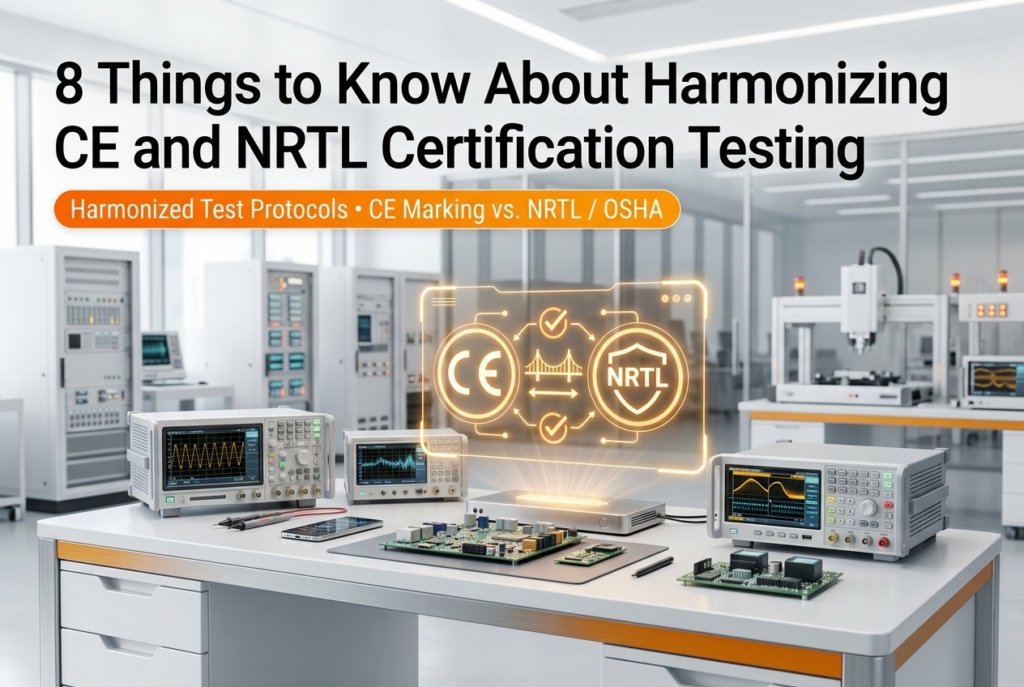
Here are eight things to know about harmonized CE and NRTL certification testing before commissioning two test programs, when one might be plenty!
1. Are North American and European Safety Standards Actually Harmonized?
Several major product categories share closely aligned technical requirements because both North American and European standards draw from the same IEC standards.
Consider:
- IT and audio/video equipment: UL 62368-1 and EN IEC 62368-1.
- Medical electrical equipment: ANSI/AAMI ES60601-1 and EN 60601-1.
- Laboratory equipment: UL 61010-1 and EN 61010-1.
- Household appliances: UL 60335 series and EN 60335 series.
National deviations, additional requirements, and differences in adoption can still factor into the equation, but their shared technical foundations create opportunities to use the same physical testing to support multiple certifications.
Industrial machinery, for example, may involve more substantial differences between applicable North American and European requirements. The trick is knowing where the overlap actually exists. Assuming everything is different is expensive, often as expensive as the inverse assumption that everything is identical.
2. Does Harmonized Testing Mean You Only Test Once?
Oftentimes, yes, and that’s where the savings come in.
When the applicable standards are sufficiently aligned, a laboratory qualified to perform both NRTL and IECEE CB Scheme testing can develop a test program that addresses the requirements of both markets.
The laboratory conducts the physical testing, documents the results, and prepares the appropriate CB Test Report. That data can then support the European compliance process and an NRTL's evaluation, subject to the applicable requirements and acceptance procedures.
The important distinction is that you're consolidating the testing, not the approvals.
Two certification pathways still exist, but the product doesn't necessarily need to endure two entirely separate rounds of the same temperature, dielectric strength, and abnormal operation testing. Even a product has limits to how many times it wants to be subjected to a bad day in the laboratory.
3. What Is the CB Scheme, and Why Does It Matter?
The IECEE CB Scheme is the international framework that helps make test data portable between participating certification bodies.
A CB Test Certificate and its supporting report provide a standardized way to communicate test results across participating countries. Rather than starting from scratch every time a product enters a new market, a certification body can review existing test data and determine what additional evaluation is necessary. For manufacturers pursuing both NRTL certification and CE-related safety compliance, this can be an extremely useful starting point.
Think of the CB Scheme as a way to keep the engineering work from getting lost at the border. It doesn't guarantee universal acceptance, but it can save considerable time and duplicated effort.
4. Will Every NRTL Accept Your CB Test Report?
No, and this is something you’ll want to wrap your mind around before testing begins. NRTLs have their own certification procedures and acceptance policies. Some may accept applicable CB test data with relatively little additional work. Others may require technical review, supplemental testing, or verification of national differences.
Acceptance depends on the product, applicable standards, laboratory qualifications, and the certification body's requirements. This is why choosing a testing laboratory and planning the certification route should happen simultaneously. Confirm that the intended NRTL will accept the proposed CB documentation before committing to the program.
PSC's NRTL certification team helps manufacturers coordinate these requirements upfront, so the test strategy actually serves the certification objective.
5. Does Harmonized Safety Testing Cover European EMC Requirements?
No, so be prepared to add a column to your budget’s spreadsheet. CE marking under the EMC Directive requires compliance with both emissions and immunity requirements. North American FCC and ISED radio frequency regulations primarily address emissions and do not provide an equivalent general immunity compliance pathway.
In theory, a product may have its electrical safety testing beautifully coordinated between North America and Europe and still need a separate European EMC evaluation. The product needs to demonstrate that it doesn't create unacceptable electromagnetic interference and that it can tolerate the electromagnetic environment in which it's expected to operate.
6. Does RoHS Compliance Come With Harmonized Safety Testing?
No. RoHS is concerned with what goes into the product physically, as opposed to how the product behaves when plugged in.
The EU RoHS Directive restricts the use of specified hazardous substances in electrical and electronic equipment. Demonstrating compliance typically involves reviewing supplier declarations, component material information, and supporting technical documentation.
None of that is established by running dielectric strength or abnormal operation tests. Manufacturers need to account for RoHS separately, ideally while selecting components and evaluating suppliers. Waiting until the end to chase material declarations is how you discover that the one component you need information about is manufactured by a company that’s certifiably MIA.
7. What About WEEE? Is That Part of Certification?
Not exactly. WEEE (Waste Electrical and Electronic Equipment) is a separate European environmental compliance obligation involving the collection, recycling, and disposal of electronic products.
Manufacturers placing covered products on the EU market generally need to address producer registration and applicable reporting obligations in the countries where they sell.
Sadly there isn't a laboratory test that will take care of this for you. WEEE is largely an administrative and financial responsibility, and the requirements can vary between EU member states. It's easy to overlook because it doesn't involve a test report, a certification mark, or anyone in a lab coat holding a beaker.
8. Does Harmonized Testing Eliminate Separate Certification Fees?
No. It eliminates potential duplicate physical testing, not the entire cost of certification.
The NRTL and European conformity assessment processes remain distinct. Certification fees, technical reviews, documentation requirements, and any necessary supplemental evaluations still apply. CE marking also requires its own EU Declaration of Conformity identifying the applicable legislation and standards. There is no North American equivalent that cleanly substitutes for it.
The financial advantage is that you're avoiding unnecessary duplication of the most resource-intensive part of the process: actually testing the product.
It's a substantial cost saving, just not the regulatory equivalent of buying one coffee and getting the entire office caffeinated.
How Should You Plan for Dual-Market Certification?
The best time to coordinate CE and NRTL testing is before the product reaches the laboratory. Once one certification program is complete, trying to retrofit the documentation and test strategy for another market can create unnecessary work.
A few things deserve attention early:
- Choose the right laboratory. Look for a lab with the appropriate NRTL capabilities and IECEE CB Scheme qualifications.
- Compare the actual standards. Identify national deviations and additional requirements rather than assuming the IEC foundation makes everything identical.
- Confirm CB report acceptance. Get the intended NRTL's agreement on the proposed documentation and testing approach.
- Budget for separate requirements. EMC, RoHS, WEEE, and other European obligations need their own place in the project plan.
A Couple of Questions Worth Answering Before You Start
Does certification to IEC 60950-1 still help with CE marking?
Not as a substitute for current requirements. IEC 60950-1 has been withdrawn and superseded by IEC 62368-1 for applicable IT and audio/video equipment. Manufacturers still relying on the older standard need to evaluate the transition to the current applicable requirements. That transition is also a good opportunity to coordinate North American and European testing under the shared IEC 62368-1 framework.
Can North American NRTL certification help with other international markets?
Absolutely, although the extent depends on the certification body and the destination country. CB Scheme participation can make existing safety test data useful in additional markets, including parts of Asia-Pacific. Country-specific approvals, national deviations, and local requirements may still apply. One test report can travel a surprisingly long way, but it doesn't come with diplomatic immunity.
PSC Helps Manufacturers Get More From Their Testing
Product Safety Consulting helps manufacturers coordinate North American NRTL certification and European CE compliance through harmonized testing strategies.
Whether you're developing a new product for both markets or extending an existing North American certification into Europe, PSC can identify where standards overlap, where additional testing is necessary, and where you're at risk of paying for superfluous work.
Visit productsafetyinc.com or call 877-804-3066 to discuss your certification strategy.