

“Has this product been tested?” “Is this product certified?”
They sound like the answers should go hand in hand. However, that’s simply not always the case. This is one of those little distinctions in product safety that seems harmless right up until a customer, regulator, retailer, or AHJ asks for certification and someone proudly hands over a test report, only to be met with puzzled looks and furtive glances.
Testing and certification are related. In fact, certification relies immensely on thorough and reliable testing. But they are not interchangeable, and understanding the difference can save you from some very expensive misunderstandings.
So, let’s clear this up before anyone puts a certification mark on something that has merely survived a leisurely Tuesday in the lab.
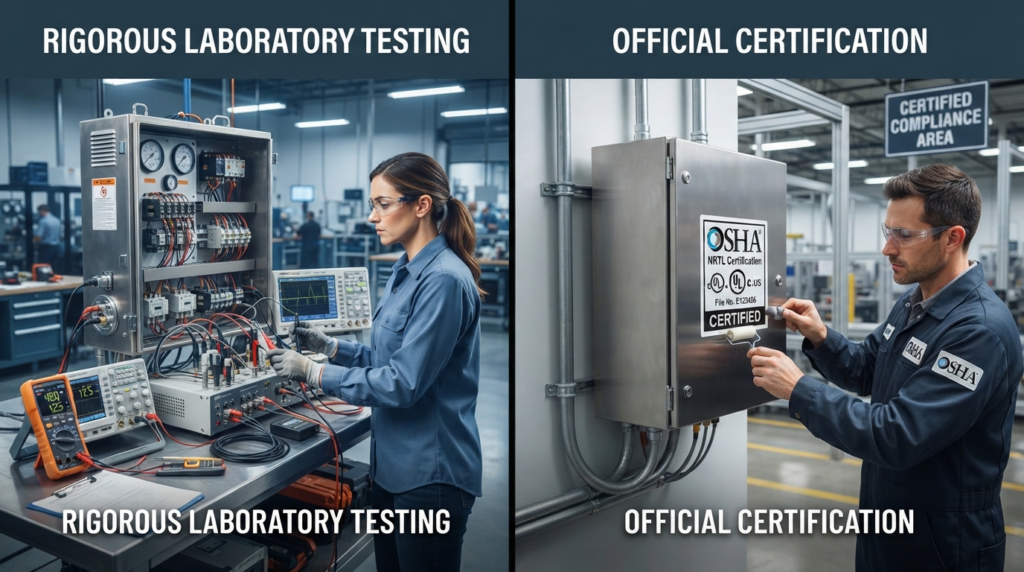
What Is Testing?
Testing is the process of evaluating a product, component, or system against defined requirements or performance criteria. In other words, testing produces evidence. Measurements. Observations. Results. Pass/fail determinations against specific test conditions.
Testing might be:
- Conducted internally by the manufacturer using in-house equipment and personnel
- Conducted by an independent third-party laboratory to provide additional objectivity
- Conducted by an NRTL or other qualified laboratory as part of a certification program
- Destructive or non-destructive, depending on what you're trying to prove and how much you enjoy watching perfectly good products get destroyed
The output is typically a test report. A test report tells you what was tested, how it was tested, under what conditions, and what happened. That's useful, but a test report is evidence of testing and nothing more. It is not, by itself, an official product certification. And that distinction should distinctly alter your posture when drafting a launch plan.
What Is Certification?
Certification takes testing a step further.It is a formal determination by an authorized third-party organization that a product has been evaluated and found to conform to the requirements of a specified standard or certification program.
Think of testing as generating the evidence and certification as having a qualified organization review that evidence and formally stand behind the conclusion.
Certification can include:
- A defined evaluation program with established scope and procedures
- Review of test results by qualified personnel
- Evaluation of the product against the applicable requirements of the standard
- Factory inspections and follow-up surveillance
- Verification that production continues to match the certified design
- A certificate, listing, or other verifiable certification record
- Authorization to apply a recognized certification mark, where applicable
So while testing tells you what happened to a particular sample under particular conditions, certification tells the market that an authorized organization has evaluated the product against the applicable requirements and determined that it conforms within the scope of the certification.
That's a considerably bigger statement.
Testing vs. Certification: The Quick Version
| Testing | Certification | |
| What it produces | Test report with data and pass/fail results | Certificate, listing, or recognized mark |
| Who conducts it | Manufacturer, third-party lab, or NRTL | NRTL or accredited Certification Body |
| Scope | Specific tests on specific samples | Full evaluation against applicable standard |
| Ongoing obligations | None — test is complete when report is issued | FUS inspections, change notification, standard updates |
| Market recognition | Test report alone does not satisfy regulatory requirements | Certification mark satisfies NRTL, AHJ, and regulatory requirements |
| Manufacturer authority | None — testing does not authorize product labeling | Yes — certification authorizes use of the recognized mark |
| Product coverage | Samples tested on a specific date | All production units of certified model |
Where the Confusion Creates Real Problems
This is where a perfectly accurate statement can become wildly misleading. A manufacturer can absolutely say, “Our product has been tested.” But if the testing wasn't performed as part of the applicable certification program, that doesn't necessarily mean the product is certified.
This matters when a customer says they require an NRTL-certified product. If you respond with a 147-page test report and a confident smile, you may not get the reaction you were hoping for. The customer didn't ask whether the product had survived a laboratory. They asked whether it was certified.
“But it passed.”
Passed what? Testing only means something in relation to what was tested and the requirements against which it was tested.
A product might have:
- Passed an internal company test
- Passed a particular portion of a standard
- Passed testing against an outdated edition
- Passed testing against a standard that isn't applicable to the target market
- Passed testing on a configuration that is no longer the configuration being sold
“Passed” is a lovely word. It is also remarkably incomplete. The next question should always be: “Passed which test, against which requirements, on which configuration?” Compliance is hinged on putting your paperwork where your mouth is.
When Testing Without Certification Is Completely Reasonable
Testing without immediately pursuing certification isn't a bad thing. You may want to test a product:
Before formal certification
Pre-compliance testing can identify problems before the official evaluation begins. This is generally preferable to discovering the problem during the official evaluation, after you've already spent money, scheduled production, announced a launch date, and assured everyone that everything is going great.
During product development
Testing can help engineers validate design decisions, compare components, and find problems while they're still relatively inexpensive to fix. Because changing a resistor is easier than changing 40,000 finished products.
To compare designs
Trying two different materials or components? Test them. Find out which one behaves better before committing to a design.
For quality control
Testing incoming components or materials can help verify that what arrived on the loading dock is actually what you ordered. A surprisingly useful concept when it comes time to assemble.
The Takeaway
Testing and certification aren't interchangeable. Testing generates evidence. Certification is a formal determination of conformity within a defined certification program.
You can have testing without certification. You cannot simply declare certification because you happen to possess a test report. And if a customer, retailer, regulator, or AHJ asks for certification, the important question isn't:
“Do we have test data?”
It's:
“Do we have the specific certification they're asking for?”
That distinction can save you time, money, and the particularly unpleasant experience of finding out that your beautifully organized compliance folder contains 200 pages of evidence that don't actually satisfy the requirement sitting in front of you.
PSC Can Help You Figure Out Which One You Actually Need
Already have testing data? Good. Don't throw it away. It may be useful.
PSC can help determine what you've already accomplished, what your existing data can support, and what additional evaluation may be needed to get you where you actually need to go.
We've been helping manufacturers navigate product safety and certification requirements since 1988, across virtually every major product category. The goal is to get the product certified, accepted, and onto the market. And preferably to accomplish all three without discovering an entirely new category of paperwork along the way.
Reach out at productsafetyinc.com or call 877-804-3066.
Frequently Asked Questions
My product was tested by an independent laboratory. Doesn't that mean it's certified?
No. But it doesn't mean the testing was useless, either. Independent laboratory data against the applicable standard may be valuable input to an NRTL certification program. Depending on the circumstances, an NRTL may be able to review and accept some existing data rather than requiring the testing to be repeated.
So don't assume your existing testing is worthless. Just don't assume it's certification, either.
I have UL test data from an older version of the product. Can I use it for the new version?
Potentially. Test data is tied to the product configuration that was evaluated. If certain aspects of the design haven't changed, some existing data may remain applicable. Your NRTL can determine what existing data is applicable and what additional evaluation may be required.
We have ISO 9001 certification. Doesn't that count?
No. And this one comes up often enough that it deserves its own shoutout.
ISO 9001 addresses quality management systems. Product safety certification addresses whether a product conforms to applicable safety requirements. They're both useful. They're just not interchangeable.
Having ISO 9001 certification does not magically transform a product into an NRTL-certified product. If only compliance worked that way.
What's the difference between “listed,” “labeled,” and “certified”?
These terms are related but aren't simply three words for the same thing.
- “Listed” generally refers to equipment appearing in an NRTL's published listing.
- “Labeled” generally refers to equipment bearing the applicable NRTL certification mark.
- “Certified” is the broader term describing conformity under the applicable certification program.
The exact terminology can depend on the NRTL and certification program involved, so if someone is using these terms interchangeably, it's worth finding out exactly what they're asking for.
Can PSC give me a letter saying my product was tested? Will that satisfy the AHJ?
PSC can document testing or evaluation work we have conducted. Whether that documentation satisfies an AHJ depends entirely on what the AHJ requires. If the AHJ requires an NRTL certification mark, a test letter isn't necessarily going to substitute for one. Which is why it's better to figure that out before you print 50,000 labels.
Product Safety Consulting, Inc. | Bensenville, IL | 877-804-3066 | productsafetyinc.com