

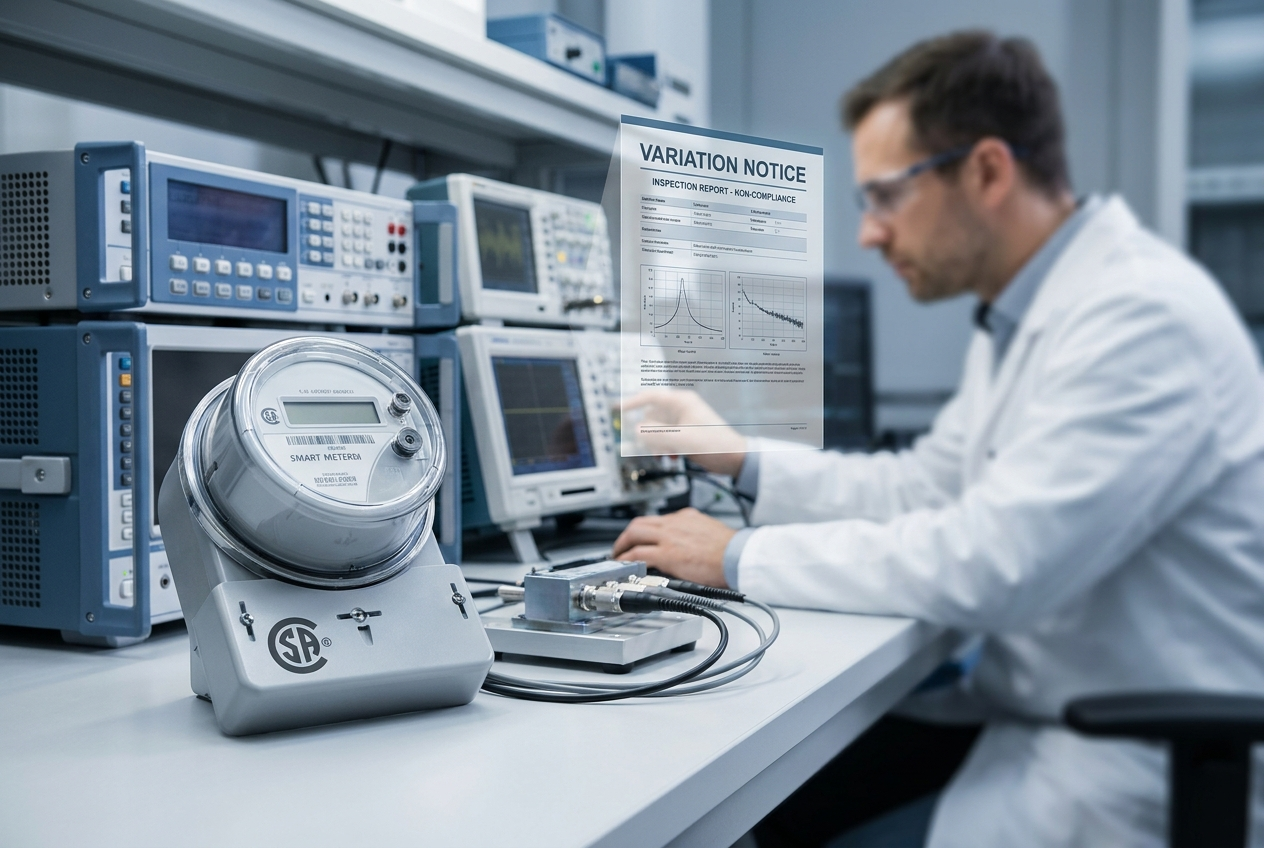
If your product carries NRTL certification (a UL, CSA, or similar listing), congratulations. You've secured a coveted spot in the safety-compliance boys' club.
The only downside is you’re never really done proving yourself to this elite bunch.
As much as we all wish NRTL certification was a one-and-done event where confetti falls from the ceiling and everyone goes home, it hardly works that way. It comes with ongoing obligations, including periodic factory inspections conducted by the certifying body. These are known as Follow-Up Services (FUS) inspections. And when an inspector discovers that the product rolling off your line doesn't match the product described in your certification records, you may receive a Variation Notice.
A Variation Notice (VN) is essentially a formal "We need to talk" letter from your NRTL. It documents non-compliances discovered during a FUS inspection. It's not a five-alarm fire, but it's definitely smoke you shouldn't ignore.
Left unresolved, Variation Notices can delay shipments, increase inspection frequency, create administrative headaches, and in severe cases jeopardize your certification status altogether.
Fortunately, most VNs are the result of a handful of predictable, preventable issues. Once you know where the banana peels are, it's much easier not to slip.
What Triggers a Variation Notice?
At its core, every FUS inspection revolves around a deceptively simple question:
Does the product being manufactured match the product that was certified?
Your certification is tied to a specific set of details—components, materials, construction methods, labels, and manufacturing processes—all documented in a Follow-Up Services Procedure (FUSP) or similar certification record.
A Variation Notice appears when reality and paperwork butt heads.
The most common triggers include:
| Common Variation Notice Trigger | What the Inspector Finds |
| Unapproved component substitutions | A different component than the one listed in the certification file |
| Material changes | Alternate plastics, insulation, wiring, adhesives, or other materials not on record |
| Labeling discrepancies | Missing, incorrect, outdated, or improperly applied certification markings |
| Construction differences | Product design or assembly doesn't match the certified description |
| Manufacturing process changes | Production methods have changed without certification review |
| Documentation issues | Required records are missing, incomplete, or outdated |
Think of your certification file as the recipe for a wedding cake. If the recipe says vanilla sponge and raspberry filling, but the bakery quietly switches to chocolate lava cake with jalapeños, nobody gets to argue, "But it still tastes good." The recipe and the cake have to match. Compliance works the same way.
What Happens After You Receive a Variation Notice?
Receiving a VN means the countdown begins.
Most certifying bodies expect a formal response—typically a Corrective Action Report (CAR)—within a defined timeframe. Thirty days is common, although exact requirements vary depending on the NRTL and the severity of the finding.
Your response generally needs to accomplish three things:
- Acknowledge the non-compliance and confirm you understand the issue.
- Explain the root cause. How did this happen?
- Describe the corrective action. What have you done or what will you do to fix it and prevent it from happening again?
The next steps depend on the type of finding.
If the issue involves a component substitution, you may need to submit a formal product change request so the alternate component can be evaluated and added to your certification record. If it's a labeling issue, you'll need to correct the labels and document the fix. If it's a process deviation, you'll likely need updated procedures, retraining records, and evidence that the change has been implemented.
Ignoring a VN is akin to ignoring a check-engine light while driving across the desert. The problem rarely becomes smaller on its own. Depending on the circumstances, the NRTL may increase inspection frequency, impose certification conditions, or begin suspension proceedings. None of those outcomes are particularly fun.
Best Practices to Avoid Receiving a Variation Notice
The manufacturers who rarely see Variation Notices aren't magicians. They simply build systems that keep surprises from sneaking onto the production floor wearing fake mustaches. Here are five habits that consistently reduce VN risk:
1. Keep your descriptive report current
If there's one hill worth planting a compliance flag on, it's this one. Your certification documentation should always reflect the product you're actually building.
Whenever a component, material, process, or construction detail changes, even if it seems minor, verify whether the change requires NRTL review before implementation. The fastest route to a VN is treating certification records like an old map stuffed in a glove compartment.
2. Establish a formal change control process
Engineering, procurement, quality, and compliance should all be riding the same wave.
A buyer may see a component substitution as a harmless cost-saving measure. An engineer may see it as a technical equivalent. An inspector may see it as a non-compliance.
Build NRTL review requirements directly into your change-control workflow so the step can't be skipped accidentally.
3. Conduct your own pre-inspection walkthrough
Before a scheduled FUS inspection, perform your own miniature version of the inspector's job. Pull the certified documentation. Walk the floor. Compare the paperwork against reality.
Check:
- Components
- Labels
- Materials
- Assembly methods
- Manufacturing procedures
If you discover discrepancies first, you have options. If the inspector discovers them first, you have a problem.
4. Control your supply chain
Supply chains are notorious shape-shifters.
A supplier updates a specification. Procurement finds a cheaper source. A substitute part appears in inventory like an uninvited raccoon at a picnic. Suddenly the product on the line no longer matches the certified record.
Require suppliers to notify you of specification changes and verify all alternate sources against certification documentation before components reach production.
5. Train the people closest to the product
Most Variation Notices come from well-meaning people making reasonable decisions without understanding the certification consequences. Production staff, quality personnel, and procurement teams don't need to become compliance gurus. They simply need to understand that changes to certified products require a process.
A little awareness prevents a surprising amount of paperwork.
Already Have a Variation Notice — or Trying to Avoid One?
Whether you're responding to a VN that's already landed on your desk or trying to build stronger systems before the next inspection, experienced guidance can save time, stress, and unnecessary back-and-forth with your NRTL.
Product Safety Consulting has helped manufacturers navigate FUS inspections, respond to Variation Notices, and build compliance programs that keep certifications clean and inspections uneventful.
We've been doing this work since 1988 across hundreds of product categories and every major NRTL.
If you'd like to discuss your situation, visit productsafetyinc.com or call 877-804-3066.
Frequently Asked Questions
Q: How much time do I have to respond to a Variation Notice?
A: Response timelines vary by NRTL and by the severity of the finding, but 30 days is a common expectation for an initial response. Some organizations apply shorter deadlines for findings involving safety-critical concerns. Review the VN carefully. The response deadline is typically stated directly in the notice.
Q: Will a Variation Notice affect my ability to ship product?
A: It depends on the finding. Administrative issues such as documentation gaps often do not result in immediate shipment restrictions. However, findings involving product safety concerns or unapproved safety-critical components can trigger shipment holds until the issue is resolved. If you're unsure, contact your NRTL representative and ask for clarification.
Q: Can I get a Variation Notice for a change that doesn't affect product safety?
A: Yes. FUS inspections verify compliance with certification documentation, not just safety performance. Even if a substitute component appears functionally equivalent, it may still require NRTL review and approval before use. The determination belongs to the certifying body, not the manufacturer.
Q: How do I get an alternate component approved so I don't keep getting VNs for the same substitution?
A: Submit a product change request, sometimes called a change notice or alternate component request, depending on the NRTL. Once the component has been evaluated and added to your certified product documentation, it becomes an approved variant and should no longer trigger future VNs.
Q: How often do FUS inspections happen?
A: Inspection frequency depends on factors such as product type, production volume, risk level, and compliance history. Quarterly inspections are common, although schedules vary. NOTE: Inspection frequency requirements are governed by OSHA's regulations (29 CFR 1910.7). Manufacturers with recurring Variation Notices or unresolved findings may be subject to more frequent inspections.
Product Safety Consulting, Inc. Bensenville, IL 877-804-3066 productsafetyinc.com