

If you've spent any amount of time specifying electrical enclosures, you've probably encountered the three monarchs of environmental protection bureaucracy: NEMA ratings, UL Type ratings, and IP ratings.
At first glance, they all seem to answer the same question: "How good is this box at keeping the outside world from doing outside-world things to the expensive electronics inside?" Reasonable question. Unfortunately, the answer arrives from three different organizations, using three different systems, speaking three different dialects of Standards Committee.
It's a bit like asking three weather forecasters whether you need an umbrella. One gives you rainfall probability, one provides a certified umbrella audit, and one hands you a 300-page document defining "wet." The confusion usually appears in two predictable ways: Someone specifies an IP-rated enclosure for a North American application that requires NEMA or UL Type. Someone notices two ratings appear similar and concludes they're interchangeable.
That's how compliance projects acquire gray hair.
Let's untangle the mystery, decode the alphabet soup, and determine which rating system is actually speaking your language.
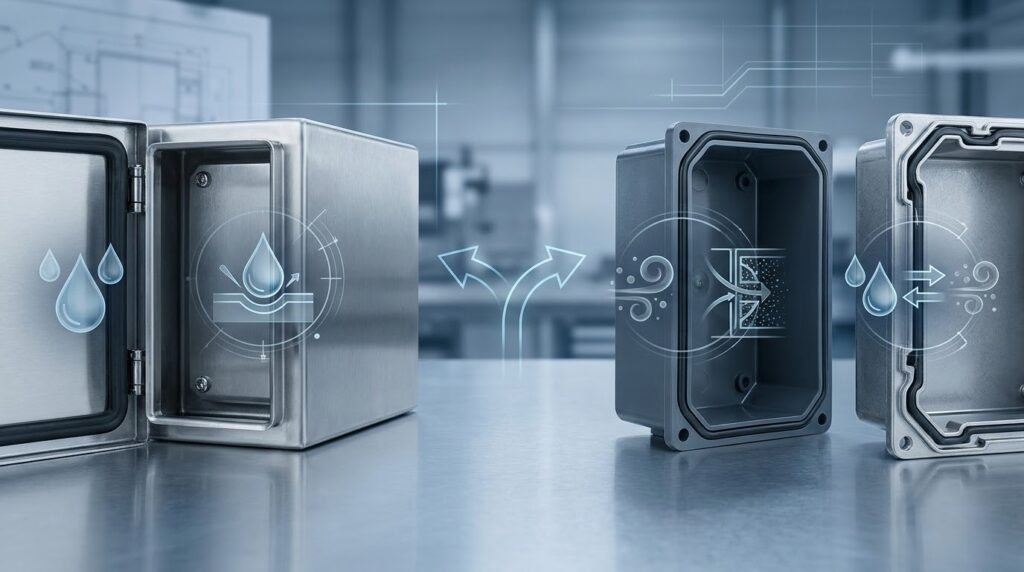
The Three Rating Systems at a Glance: NEMA, UL Type, IP (IEC 60529)
| NEMA | UL Type | IP (IEC 60529) | |
| Governed By | National Electrical Manufacturers Association | Underwriters Laboratories | International Electrotechnical Commission (IEC) |
| Primary Market | North America | North America | International (Europe, global) |
| Rating Format | Single number or number + letter (e.g., NEMA 4X) | Type number (e.g., Type 4X) | Two-digit code (e.g., IP65) |
| Covers | Environmental protection + additional factors (corrosion, icing, etc.) | Environmental protection + UL safety certification | Ingress protection only (solids and liquids) |
| Certification Required | No — self-declared by manufacturer | Yes — UL certification required | No — self-declared, though often tested by third parties |
The important takeaway:
These systems overlap like three Venn diagrams trapped in an elevator together, but they're not the same thing.
NEMA Ratings
NEMA ratings are defined in NEMA 250, and they take a broad view of environmental protection.
While IP ratings mostly ask, "Can dust and water get in?" NEMA asks: Can dust get in? Can water get in? Can ice form on it? Can oil attack it? Can corrosion turn it into a failed lab experiment? Will it survive being installed somewhere humans inevitably regret installing equipment?
NEMA ratings are generally self-declared, meaning manufacturers can state compliance without mandatory third-party certification. That doesn't mean they're making it up on a napkin at lunch. Many manufacturers voluntarily test and certify their enclosures. But the system itself doesn't require it.
Common NEMA Ratings
NEMA 1
The "please leave me indoors" rating. Provides basic protection against accidental contact and falling dirt.
NEMA 4
The rugged raincoat. Dust-tight, watertight, and capable of handling hose-directed water.
NEMA 4X
Everything NEMA 4 does, but with corrosion resistance added. Think of NEMA 4 wearing stainless-steel armor.
NEMA 12
Built for industrial environments where dust, grime, and mysterious fluids periodically materialize without explanation.
NEMA 6P
The submarine captain of enclosure ratings. Designed for prolonged submersion. Not merely wet. Committed to wetness.
UL Type Ratings
UL Type ratings live primarily in UL 50 and UL 508A and often look suspiciously similar to NEMA ratings. That's because many of the performance requirements are, in practical terms, extremely close. The crucial difference is certification. A UL Type rating is a claim that has survived contact with a third-party testing organization.
For products seeking UL certification in North America, using a UL Listed enclosure can dramatically simplify the evaluation process. The certifying engineer doesn't need to reinvent the wheel. The enclosure has already stood before the tribunal of testing and emerged with documentation.
A non-listed NEMA enclosure may still work perfectly well. It simply arrives carrying more homework. And no engineer has ever said: "I wish this certification project involved more paperwork."
IP Ratings
IP ratings come from IEC 60529 and dominate much of the world outside North America.
The system uses two digits: First digit = protection against solids. Second digit = protection against liquids. Elegant. Concise. Ruthlessly numerical. Like a European train schedule.
IP Rating Breakdown
| 1st Digit | Solid Protection | 2nd Digit | Liquid Protection |
| 0 | No protection | 0 | No protection |
| 1 | Objects > 50mm | 1 | Vertically dripping water |
| 2 | Objects > 12.5mm | 2 | Dripping water (15° tilt) |
| 3 | Objects > 2.5mm | 3 | Spraying water |
| 4 | Objects > 1mm | 4 | Splashing water |
| 5 | Dust protected | 5 | Water jets |
| 6 | Dust tight | 6 | Powerful water jets |
| 7 | Immersion up to 1m | ||
| 8 | Immersion beyond 1m | ||
| 9 | High pressure/steam |
So an IP65 enclosure is dust-tight (6) and protected against water jets from any direction (5). An IP67 is dust-tight and can handle temporary immersion to 1 meter.
How They Relate to Each Other
This is where many engineers wander into the swamp. The ratings often have similar environmental performance characteristics. That does not mean they're interchangeable.
A wolf and a German shepherd both have four legs and teeth. Compliance departments still prefer you identify them correctly.
The following is commonly used as a reference:
| NEMA | UL Type | Approximate IP | Key Protection |
| NEMA 1 | Type 1 | IP10 | Indoor, general purpose |
| NEMA 2 | Type 2 | IP11 | Drip-proof, indoor |
| NEMA 3 | Type 3 | IP54 | Outdoor, windblown dust and rain |
| NEMA 3R | Type 3R | IP14 | Outdoor, falling rain |
| NEMA 4 | Type 4 | IP56 | Watertight, hose-directed water |
| NEMA 4X | Type 4X | IP56 | Watertight + corrosion resistant |
| NEMA 6 | Type 6 | IP67 | Submersible (temporary) |
| NEMA 6P | Type 6P | IP68 | Submersible (prolonged) |
| NEMA 12 | Type 12 | IP52 | Industrial, dripping liquids and dust |
| NEMA 13 | Type 13 | IP54 | Oil-tight, dust-tight |
The Caveat That Saves Projects
This table represents approximate equivalencies, not compliance equivalencies. That's an important distinction. The sort of distinction that determines whether your certification review lasts two days or two months.
NEMA includes factors IP does not evaluate. UL Type includes certification that IP does not require. IP focuses specifically on ingress protection and leaves many other environmental concerns outside the scope.
So if a standard requires NEMA 4X, showing up with IP56, hope, and little else is unlikely to end the conversation. When a regulation requires a specific rating, you need that specific rating. Compliance professionals have a remarkable ability to distinguish between "equivalent" and "actually required."
Not Sure Which Rating Your Application Requires?
Enclosure rating questions show up in certification projects with the consistency of gravity.
Choosing the correct enclosure early can prevent:
- Design rework
- Certification delays
- Additional testing
- Failed evaluations
- Lengthy discussions that begin with "How did we get here?"
Whether you're developing a new product, preparing for UL certification, pursuing CE compliance, or evaluating existing equipment, understanding the relationship between NEMA, UL Type, and IP ratings can save significant time and cost.
Product Safety Consulting has been helping manufacturers navigate these requirements since 1988. We work across NRTL certifications, CE marking, and field evaluations, where enclosure rating questions appear with surprising regularity.
Visit productsafetyinc.com or call 877-804-3066 to discuss your project.
Frequently Asked Questions
Q: If an enclosure passes IP65 testing, can I claim it meets NEMA 4?
A: Not automatically. IP65 and NEMA 4 overlap in several water-ingress performance areas, but NEMA 4 includes additional requirements such as protection against external ice formation. In other words, IP65 answers many of the questions. NEMA 4 asks a few more.
Passing one does not automatically earn you the other.
Q: Does it matter whether I use a NEMA-rated versus a UL Type-rated enclosure for UL certification?
A: Yes. A UL Listed enclosure arrives with independent certification already established. A NEMA-rated enclosure without UL Listing may still be acceptable, but additional evaluation is typically required.
Q: Which rating system should I use for a product sold in both the US and Europe?
A: Usually both. North American customers commonly expect NEMA or UL Type ratings. European and international markets typically expect IP ratings. Fortunately, many enclosure manufacturers publish multiple ratings for the same product. The important step is verifying compliance in each target market rather than assuming one rating automatically satisfies all requirements.
Q: Is a higher NEMA or IP rating always better?
A: No. Higher ratings often mean higher costs, larger enclosures, more restrictive installation requirements, and additional complexity. Specifying a NEMA 4X stainless-steel enclosure for an indoor office application is a bit like commuting to work in an armored amphibious vehicle. Impressive and possibly unnecessary. The best rating is the one that matches the actual environment.
Q: Who is responsible for ensuring the enclosure rating is correct—the manufacturer or the installer?
A: Both. The manufacturer is responsible for selecting and certifying an enclosure that satisfies applicable standards during design and evaluation. The installer is responsible for maintaining that protection level in the field. A NEMA 4 enclosure with improperly sealed conduit entries is rather like a submarine with the screen door left open. The original design may have been flawless. The final result is still getting wet. During field evaluations, both the design and the actual installation are assessed.