

Both a field evaluation and a factory certification result in a recognized safety mark on your product. Both are accepted by AHJs across North America. But they are fundamentally different processes — with different scopes, different costs, and different use cases. Choosing the wrong one wastes time and money.
The confusion is understandable. From the outside, the end result looks similar: a label on the equipment that tells an inspector it's been evaluated. But how you get there, what it covers, and what your ongoing obligations are differ significantly between the two.
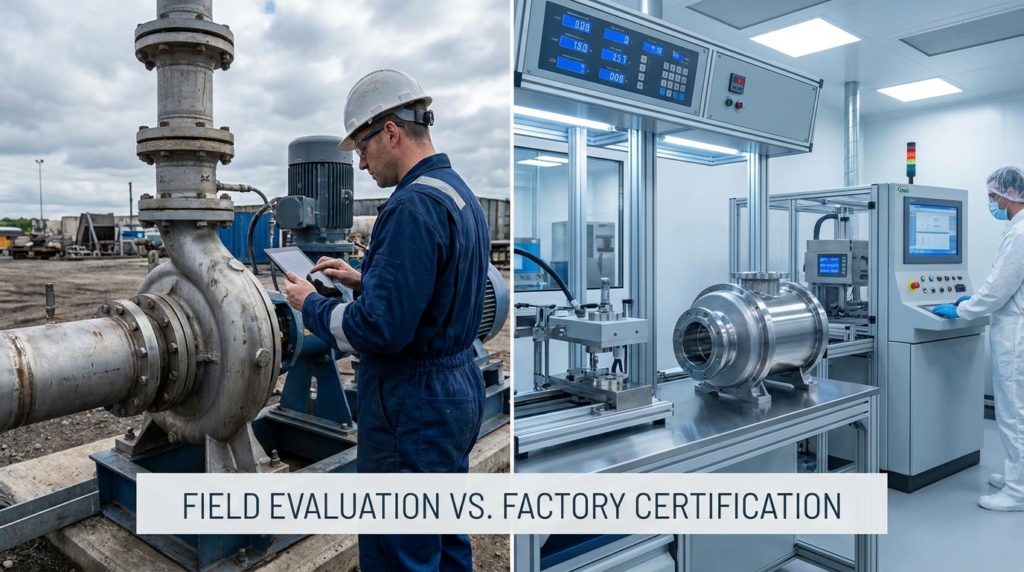
Field Evaluation: The One-Time On-Site Assessment
A field evaluation (FE) is a non-destructive, one-time investigation conducted at the equipment's location by an evaluator from an NRTL-accredited field evaluation program. The evaluator assesses the specific piece of equipment against the applicable product safety standard. If it passes, a certification label is affixed to that unit. The evaluation is complete.
Key characteristics of a field evaluation:
- Conducted on-site at the equipment's location
- Non-destructive — the equipment is not damaged or disassembled beyond what's needed for inspection
- Covers the specific unit evaluated — not all units of that model
- No ongoing factory inspections required after the label is applied
- Typically faster to initiate — PSC can be on-site within 24–48 hours
- Cost typically ranges from $3,000 to $10,000 depending on complexity
Field evaluations are the right choice when equipment is already installed and needs certification after the fact; when equipment was imported without North American certification; when equipment is custom-built; when equipment was modified after its original certification; or when you need a resolution quickly due to a red tag.
Factory Certification: The Ongoing Production Program
Factory certification (FC) is a formal product certification program where the manufacturer submits the product to a Certification Body (CB) for comprehensive evaluation and testing — including destructive testing. If the product passes, the manufacturer is authorized to apply the certification label to every unit produced during manufacturing.
Key characteristics of factory certification:
- Conducted at the CB's laboratory, not at your facility
- Includes destructive testing — some test samples may not be usable after evaluation
- Covers all production units of the certified model — not just one specific unit
- Requires ongoing Follow-Up Services (FUS) inspections — typically four times per year
- Manufacturer must maintain certification documentation and notify CB of product changes
- Higher upfront investment but covers unlimited production volume
Factory certification is the right choice when you're a manufacturer producing multiple units of the same product; when you need a mark that applies to every unit off the production line; or when you're bringing a new product to market through established retail or distribution channels.
Side-by-Side Comparison
| Field Evaluation | Factory Certification | |
| Location | At the equipment's site or facility | At the CB's laboratory |
| Testing type | Non-destructive inspection | Includes destructive testing |
| Coverage | Specific unit(s) evaluated | All production units of certified model |
| Speed | On-site within 24–48 hours | Weeks to months depending on complexity |
| Ongoing requirements | None after label is applied | Quarterly FUS inspections; change notification |
| Best for | Installed, imported, custom, or modified equipment | Manufacturers producing multiple units for market |
| Cost | $3,000–$10,000 per engagement | Higher upfront; amortized across production volume |
| Label applicability | Labeled unit only | All units produced under the certification |
Can You Do Both?
Yes, and in some cases it makes sense to. A manufacturer might use a field evaluation to get a specific piece of equipment cleared quickly while pursuing factory certification for the product line at the same time. The FE gets operations running; the FC establishes the long-term compliance infrastructure.
Not Sure Which Path Is Right for Your Situation?
Product Safety Consulting has been conducting both field evaluations and factory certifications since 1988. We can assess your specific situation — the equipment, the timeline, the AHJ requirements, and your production model — and recommend the right approach. Reach out at productsafetyinc.com or call 877-804-3066.
Frequently Asked Questions
Q: Can a field evaluation label be used as the basis for factory certification?
A: Not directly. A field evaluation covers a specific unit; factory certification covers a product design. However, the technical work done during a field evaluation can inform and accelerate the factory certification process. If you're planning to pursue factory certification after a field evaluation, let PSC know so we can structure the FE work accordingly.
Q: How long does factory certification typically take?
A: Realistic timelines range from a few weeks for straightforward products to several months for complex equipment. Planning for certification early in the product development process — rather than at the end — is the single most effective way to avoid delays.
Q: What happens to my factory certification if I change a component?
A: You're required to notify your Certification Body before making changes that could affect the certified design. Depending on the nature of the change, the CB may accept it with documentation, require limited additional testing, or require a full re-evaluation. Making changes without notifying the CB can result in a Variation Notice during a FUS inspection.
Q: Are field evaluation labels recognized in Canada?
A: Yes. Field evaluation programs from OSHA-approved NRTLs are broadly accepted in both the US and Canada. Canadian AHJs are generally familiar with and accepting of field evaluation labels from recognized programs.
Q: What's the difference between a CB and an NRTL?
A: In the US context, an NRTL is a testing and certification organization approved by OSHA. Many NRTLs are also Certification Bodies. In the CE marking context, a CB is a third party authorized to issue conformity certificates under specific EU directives. PSC works within both frameworks depending on the target market.
Product Safety Consulting, Inc. | Bensenville, IL | 877-804-3066 | productsafetyinc.com