

The gravest mistakes leading to delays in ANAB/ILAC testing are usually made long before testing itself is even a thought. They’re made long beforehand, when a project arrives with half the documentation it needs and everyone discovers that the missing half has been scattered between an engineer’s desktop and a supplier’s inbox.
A project with complete documentation can move straight into evaluation. But a project with gaps tends to make everyone a bit more chatty (albeit begrudgingly), leading to questions, follow-up questions, and the occasional archaeological expedition into the product’s design history. Weeks can disappear this way without a single test getting started.
What ANAB/ILAC Accreditation Means for Your Test Results.
ANAB accredits the laboratories that carry out this testing, and that accreditation gives the results their international standing. Because ANAB is a signatory to the ILAC Mutual Recognition Arrangement, results from appropriately accredited laboratories can be accepted across participating economies, often without requiring the entire testing process to be repeated. It’s a rather useful arrangement, provided the lab can first establish what, precisely, it has been asked to evaluate.
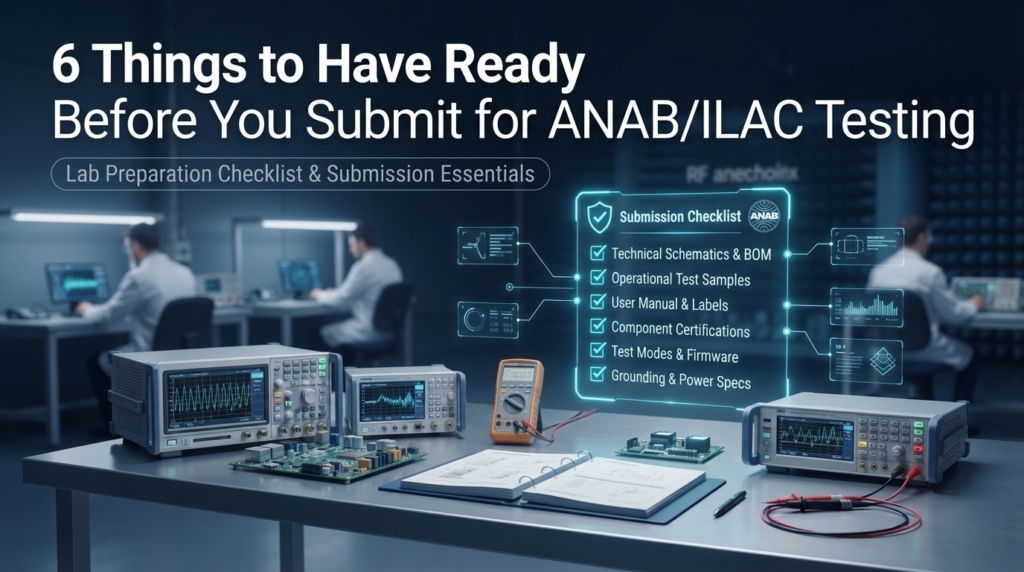
Here are six things worth having ready before you submit, each of which can help keep your project moving instead of sending it into an extended holding pattern and/or a protracted standoff with Father Time.
1. Complete Electrical Schematics
A product's electrical schematics are, contrary to popular belief, more than festive exercises for people who enjoy staring at lines and tiny rectangles. They tell the evaluator how the product is put together electrically, where hazards might arise, and which parts of the design need closer scrutiny.
Without the complete circuit design, the lab cannot properly assess the relevant hazards or determine the necessary evaluation. A missing section of a schematic is like asking someone to investigate a house while keeping the entire second floor behind a curtain.
If a section is missing, the lab will need it before the affected evaluation can proceed. The clock keeps ticking, naturally, but the testing has nowhere useful to go.
2. A Full Bill of Materials
A complete bill of materials (BOM), preferably with manufacturer names and part numbers, tells the lab what actually went into the product. That information helps the evaluator identify components that are already certified or recognized, distinguish those that need additional investigation, and determine where further testing may be necessary.
This is where a little administrative housekeeping can save a surprising amount of engineering time. A component with an existing, applicable recognition may not need to be evaluated from scratch, whereas an unidentified component can turn a straightforward review into a scavenger hunt wherein the participants would much rather be doing engineering.
A BOM that lists a power supply as “power supply” is technically making a contribution to the effort, but not a particularly useful one. Manufacturer part numbers give the lab something concrete to investigate and can help establish the scope of testing much sooner.
3. User Manuals or Instructions
Testing evaluates a product in the context of its intended use, not merely as a collection of interesting electrical parts assembled into a box. Installation instructions, operating procedures, maintenance requirements, and other information about how the product is supposed to function help determine which requirements apply.
A device intended for a controlled industrial environment may raise different evaluation questions from one designed for ordinary household use, even if certain components look remarkably similar. The instructions help establish that context before anyone starts making assumptions.
Without them, the evaluator is left trying to reconstruct the manufacturer's intentions from the hardware alone. That is an entertaining premise for a detective novel, but not an efficient way to scope a compliance project. Labs tend not to guess, and for good reason: the product's intended use can change what needs to be assessed.
4. Documentation for Any Pre-Certified Components
If your product contains a power supply or another component that already carries its own certification or recognition, have the supporting documentation ready. Where the existing certification is applicable to the component's use in your product, the evaluator may be able to rely on that work rather than repeat evaluations unnecessarily.
This is one of the rare occasions when someone else's paperwork can genuinely improve your day. The catch, of course, is that the lab needs to establish what the certification covers and whether its conditions are satisfied in the finished product. A certification mark is useful evidence, not a magical force field that protects every component from further questions.
Component documentation is not always required in every circumstance, but when it is available and relevant, it can help narrow the evaluation and prevent unnecessary duplication of effort. Keep the certificates, recognition information, and applicable conditions somewhere more accessible than a desktop folder from three product generations ago.
5. Prior Test Reports
If the product, or a close relative of it, has been tested before, dig out the reports. They may come from a different laboratory, relate to an earlier design, or have been prepared against a different standard, but that history can still give the evaluator an invaluable starting point.
Previous reports may identify components already investigated, explain design decisions, or provide test data that helps inform the current evaluation. They will not automatically replace new testing, particularly when the product, requirements, or intended use have changed, but they can save the evaluator from approaching every question as though the product was born yesterday in a plume of purple manufacturing smoke.
The important distinction is that historical results provide context; they do not guarantee acceptance of the current design. The evaluator still needs to determine what applies, what has changed, and what must be verified again.
6. A List of Target Markets
This one is easy to overlook because it doesn't look especially technical. There are no circuit diagrams, no component numbers, and generally nothing that would launch an electrical engineer into a lengthy diatribe. Yet knowing where you intend to sell the product can change how the certification project should be planned.
ANAB/ILAC-accredited test reports are accepted in many international contexts, thanks in part to the ILAC Mutual Recognition Arrangement. However, acceptance depends on the applicable scheme, regulatory requirements, scope of accreditation, and destination market. Some markets or certification pathways require additional documentation or a different deliverable, such as a CB Test Certificate issued under the IECEE CB Scheme, which facilitates the international recognition of test results and certification among participating national certification bodies.
Russia and Israel, for example, may involve additional or different national requirements depending on the product and the route to market, so neither should be treated as a blanket case where a CB Certificate is always required. The important thing is to identify the destination markets early enough for the lab and certification team to establish what you'll actually need.
Why This List Actually Affects Your Timeline
Every missing piece of information creates a little obstacle that must be overcome before the relevant part of the evaluation can move forward.
It also explains why reliable cost and timeline estimates depend on an initial documentation review. A lab can provide a rough estimate based on partial information, but a firm quote requires a much clearer understanding of the product, the components, and the applicable requirements. The details that determine how much work is involved tend to hide in the schematics and BOM, where they are considerably more hair-raising than a cursory product summary
Even a seemingly small design detail can change the evaluation required, which is why the documentation review matters before the project is fully underway. It gives the lab a chance to identify the work ahead rather than discover it one unanswered question at a time.
And if you don't have every item on this list ready, there is no need to abandon the project and take up goat farming. Late-stage design changes can still be managed, although affected areas may need to be re-evaluated. Documentation that reflects the design as it approaches final production generally reduces the risk of avoidable rework later.
What to Do If You're Not Sure What You Have
Not knowing whether your documentation is complete is a perfectly reasonable place to begin. Product designs evolve, suppliers change components, and the document trail doesn't always evolve with them. Sometimes the engineering is beautifully organized while the paperwork appears to have been assembled during a power outage.
Understanding what ANAB/ILAC testing actually involves and what it is likely to cost becomes much easier when someone experienced can review what you already have. You may be closer to submission than you think, or you may discover a few gaps worth addressing before they become memories referenced only in hushed tones.
Either way, finding out early is preferable to learning about missing documentation when everyone is waiting for the next phase to begin.
Get Your Documentation Reviewed Before You Submit
PSC's NRTL certification team can review your existing documentation, identify what's missing, and help establish a realistic cost and timeline before you formally submit for testing. The goal is to understand the work ahead, resolve avoidable questions early, and keep the project moving toward certification.
Contact John Allen and the Product Safety Consulting team at productsafetyinc.com or call 877-804-3066.